
Life Is Alive: Receive. Savor. Offer. Release.
Cultivating a Contemplative Rhythm of Love
by Jasmine Bellamy
Stillpoint Executive Director
sebastian-enrique-unsplash.jpg
“The awareness that the universe is dynamic gives to the individual the quiet assurance that wherever he may be located he is in immediate candidacy for the strength that comes from a boundless vitality.”
Life is alive.
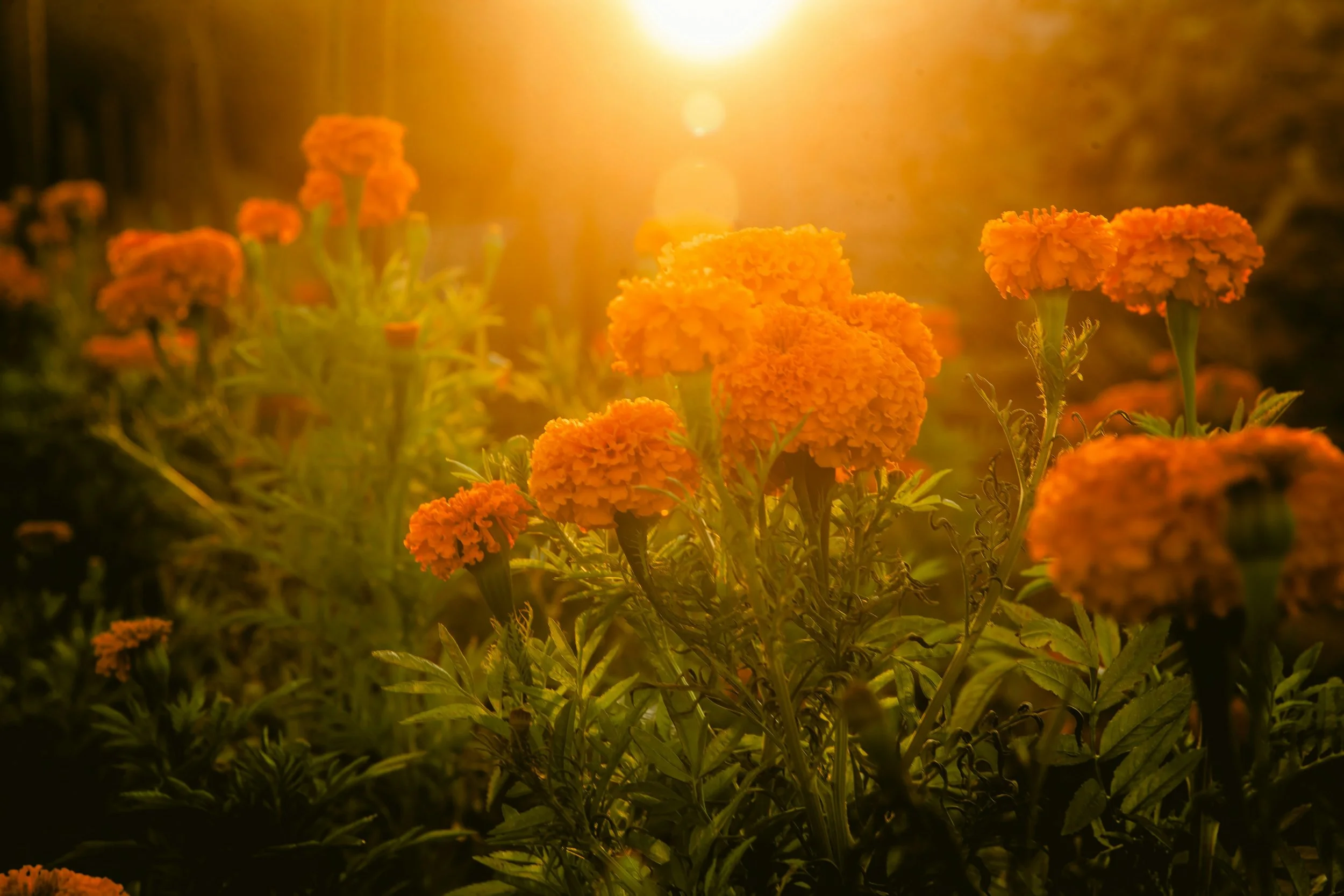
Sometimes it takes something as ordinary as a bunch of orange marigolds to remind me.
This past Sunday was filled with so many of the simple pleasures that make a day feel wonderfully complete. On our way to brunch, my beloved and I wandered through a local farmers market. We weren’t in a hurry. We had nowhere else we needed to be in that moment.
As we strolled, I began noticing people carrying beautiful bunches of orange marigolds. Their vibrant color seemed to leap out against the backdrop of ordinary life. Everywhere I turned, another burst of orange! Each encounter brought a fresh moment of delight.
Hours later, on our way to dinner, there they were again.
By then, these flowers had been accompanying me throughout the day, inviting me to notice their beauty. I was so delighted that I felt compelled to purchase a bunch for our hosts.
There was something tender about that impulse. I wanted to offer someone else what had been bringing me joy.
We arrived, received the warmth of their hospitality, and shared a beautiful evening together. When we departed, the marigolds remained, a small offering of beauty that would continue to brighten their home in the days ahead.
It wasn’t until later that I began to recognize something else unfolding in that ordinary Sunday.
Receive. Savor. Offer. Release.
A rhythm of Love had been quietly revealing itself.
Contemplation: Learning to Notice What Is Already Here
I am both a steward of contemplative institutions and a student of the contemplative path, a path shaped by a long and rich lineage of wisdom, practice, and lived experience.
Lately, I’ve been returning to a definition of contemplation from Carmelite scholar Ernest E. Larkin, which Dr. Barbara A. Holmes amplifies in Joy Unspeakable. Larkin describes contemplation as “knowledge by way of love,” and speaks of it as what remains in our “body, soul, and spirit as the aftermath of my meditation.”
I find myself lingering with that understanding.
Contemplation is not simply what happens when we close our eyes, enter silence, or withdraw from the busyness of the world. It is also what happens because we have practiced becoming still.
What remains with us when the silence ends?
How do our practices shape the way we see, listen, relate, and respond?
Do we become more available to the beauty around us? More tender toward our own humanity? More attentive to the lives of others?
Howard Thurman reminds us of the vitality that connects all living things. His vision of a “universal kinship” invites us to recognize that our lives are not isolated from one another or from the larger movement of creation.
And as Dr. Holmes reminds us, the inward journey is not merely a private undertaking. Our contemplation has communal implications.
We become still not to escape the world, but to become more fully present within it.
Perhaps this is one reason we gather in community at Stillpoint: to practice noticing, listening, and becoming together.
A Rule of Life: Making Room for Love
As the seasons change, I have also been revisiting my rule of life.
Ruth Haley Barton, in Sacred Rhythms, describes a rule of life as an intentional way of ordering our lives around the values, practices, and relationships that keep us open to God’s transforming presence.
She writes, “A rule of life provides structure and space for our growing.”
I love that pairing: structure and space.
A rule of life is not another set of demands to fulfill or a spiritual checklist to complete. At its best, it creates the conditions in which we can become increasingly available to Love.
For me, a rule of life is an intentional ordering of my life around Love.
It is a way of asking: What practices help me live from my truest self? What rhythms sustain my capacity to be present, to receive, and to offer Love in the world?
As I’ve been attending to the transitions unfolding in my own life, and particularly embracing savoring as an invitation for this season, I’ve begun noticing a fourfold rhythm emerging.
Receive
Become available to what life is offering without immediately evaluating, controlling, or trying to make something of it.
Receiving asks us to practice openness. It invites us to recognize that not everything good must be earned, produced, or pursued.
Sometimes goodness is already here, waiting to be noticed.
Like orange marigolds at a farmers market.
Savor
Attend to the goodness of what is present, allowing ourselves to experience it fully.
Savoring invites us to linger.
How often do we hurry past beauty, joy, tenderness, or even the quiet gift of another person’s presence because we are already anticipating what comes next?
What might happen if we allowed ourselves to enjoy what is good without needing it to become something more?
Savoring is not a denial of life’s difficulties. It is a refusal to let difficulty have the only word.
Offer
Let what we have received become a gift through our presence, relationships, and actions.
The contemplative life is not meant to end with our own experience of peace or delight.
Love moves.
What we receive can become hospitality. What we savor can become generosity. What we learn in silence can become deeper listening, compassion, courage, and care.
Sometimes offering looks like a courageous act of solidarity. Sometimes it looks like being fully present to someone who longs to be heard.
And sometimes it looks like a bunch of marigolds placed into another person’s hands.
Release
Loosen our grip on outcomes, expectations, and the need to hold on.
Release invites us to trust that what we have offered does not have to remain ours.
The flowers stayed with our hosts. Their beauty would continue beyond my presence, in ways I would neither witness nor control.
There is freedom in that.
We cannot possess every beautiful moment, preserve every experience, or determine what will grow from the gifts we offer.
Release makes room for rest, trust, and the possibility of receiving again.
Receive. Savor. Offer. Release.
Not a rigid sequence to master, but a living rhythm to inhabit.
Cultivating the Conditions for Peace
I wonder whether some of our deepest longings—for peace, connection, tenderness, and a more loving world—begin with the rhythms we practice in our ordinary lives.
We live amid profound uncertainty, division, suffering, and collective weariness. There are days when the heaviness of the world can make beauty seem distant and joy feel almost inappropriate.
Yet life remains alive.
The contemplative path does not ask us to ignore the suffering of the world or turn away from the realities of injustice. Rather, it invites us to cultivate the interior conditions from which loving action can emerge.
We learn to welcome our humanity, including our wounds and limitations, without allowing them to define the whole of who we are.
We practice becoming available to peace without pretending that everything around us is peaceful.
We discover that joy and grief can coexist, that tenderness is not weakness, and that Love can remain a living reality even in the midst of crisis.
Perhaps this is part of the slow work of contemplation: nurturing greater congruence between the Love we profess, the lives we inhabit, and the ways we encounter one another.
Not perfection, but practice.
Not arrival, but becoming.
And always, the invitation to begin again.
An Invitation for This Season
As you consider the season you are inhabiting, I invite you to reflect:
What word or invitation is calling to you in this season of your life?
What does your soul need or long for?
What rhythms are sustaining you, and which ones might need to change?
Where might Beauty, Joy, or Love already be meeting you, even amid the heaviness of life?
What are you being invited to receive, savor, offer, or release?
Perhaps you might begin simply by noticing.
A flower. A conversation. A moment of stillness. An unexpected kindness. A quiet stirring within.
Life is alive, and we are invited to participate in its unfolding.
Join Us This Advent
Contemplation in a Time of Crisis: Beauty, Joy, and Love
A Stillpoint Virtual Advent Retreat
Saturday, December 5, 2026 | 9:00 AM–12:30 PM PT
Facilitators: Leonetta Elaiho, Dr. Donny Bryant, and Jasmine Bellamy
Registration: $50, including access to the retreat recording.
Advent invites us into the sacred tension of waiting and becoming, of holding both the world’s suffering and the promise of new life.
Inspired in part by the transformative scholarship of Dr. Barbara A. Holmes, we will explore how contemplative practices help us remain open to beauty, available to joy, and rooted in Love, even when the world around us feels overwhelmed by crisis.
Through reflection, contemplative practice, and shared conversation, we will consider how these gifts nourish our inner lives and shape our engagement with the world.
Beauty, Joy, and Love are not waiting for the crisis to end.
They are invitations to live more fully, faithfully, and courageously within it.
Be Still. Belong. Become.
Jasmine Bellamy
Executive Director
Stillpoint: The Center for Christian Spirituality

Jasmine Bellamy is the Executive Director of Stillpoint: The Center for Christian Spirituality and the founder of Love 101 Ministries and The LOVING Leader. A spiritual director and contemplative preacher, she is a doctoral candidate at Fuller Seminary, where her research centers on how love forms the inner life of leadership. She is a graduate of Stillpoint’s BIPOC Spiritual Journey Program and received her Certificate in Spiritual Direction through Liberated Together. Through her work, Jasmine integrates contemplative practice, spiritual formation, and leadership development to support individuals and communities in living and leading from love as a daily practice.